Partnering with Online Travel Agents (OTAs) like Booking.com and Agoda is a common strategy in the hospitality industry. OTAs help increase visibility, expand market reach, and generate bookings quickly.
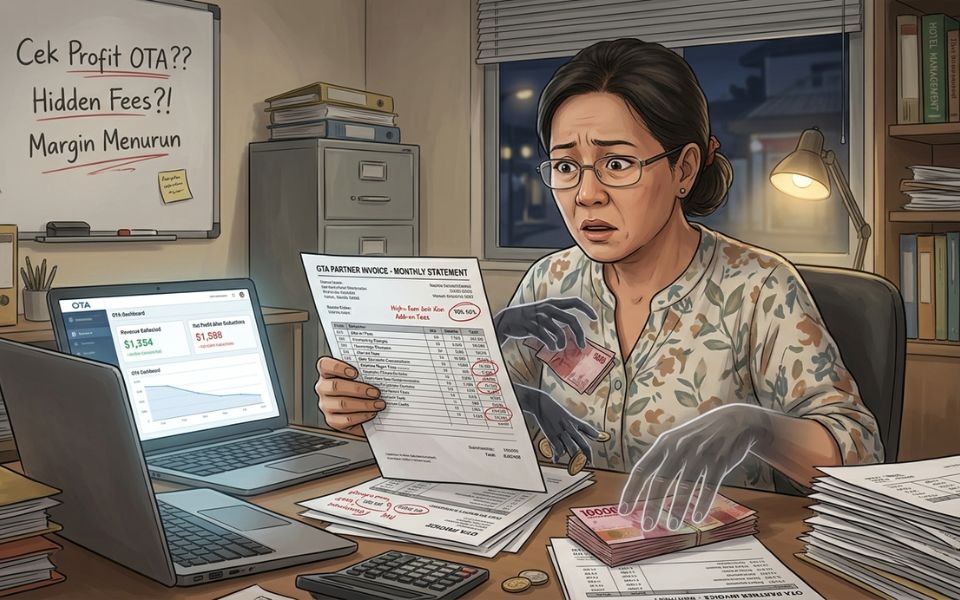
However, behind this convenience, there are various "hidden costs" that hotel owners often don't realize. If not carefully calculated, these costs can significantly erode profits and make a hotel's e-commerce performance appear good on the surface, but actually unhealthy.
OTA Commissions Seem Small, But Have a Big Impact
Most OTAs charge a commission in the range of 15–25% per booking. At first glance, this seems reasonable, especially if the hotel receives a large number of reservations.
But the problem isn't just the commission figure, but the long-term impact. When the majority of bookings come from OTAs, hotels become overly dependent on third parties. Profit margins are automatically thinner than with direct bookings.
In the context of hotel marketing strategy, this situation can be less than ideal because the hotel loses full control over the sales channel.
Additional Costs to Increase Visibility
Many hotels don't realize that to gain a higher visibility on OTAs, they have to "pay more." This can be through preferred partner programs, additional discounts, or special campaigns suggested by the OTA.
Indirectly, hotels sacrifice margins to gain exposure. Without a clear strategy, these costs are often poorly measured and difficult to evaluate their long-term effectiveness.
Pressure to Offer Deeper Discounts
OTAs often push hotels to offer more competitive prices to compete on their platforms. This triggers price wars between properties.
As a result, hotels not only pay commissions but also lose potential revenue due to underpricing. This is one of the biggest hidden costs that often goes unnoticed in hotel ecommerce.
Loss of Data and Customer Relationships
One rarely discussed loss is the loss of access to guest data. When bookings come from OTAs, customer data is very limited, and communication is also restricted by the platform.
However, in hotel marketing strategies, data is a crucial asset for retargeting, upselling, and building customer loyalty. Without sufficient data, hotels will continue to rely on OTAs for new bookings.
Indirect Costs of OTA Dependence
Over-reliance on OTAs also creates indirect costs. Hotels struggle to build their own brand, direct bookings are low, and long-term marketing costs actually increase.
In the long term, this can make businesses less stable due to over-reliance on one primary traffic source.
Why is Optimizing Hotel Ecommerce Important?
OTAs remain important as a distribution channel. However, relying solely on OTAs is not a healthy strategy.
Hotels need to start balancing OTAs and direct bookings by building a robust hotel ecommerce system. This includes an optimized website, the right digital advertising strategy, and a marketing funnel capable of converting traffic into direct bookings.
With the right strategy, hotels can not only increase revenue but also maintain healthy margins. Hidden costs of OTAs extend beyond commissions to discounts, visibility fees, data loss, and long-term dependency.
Without realizing it, all of this can slowly erode profits. Therefore, it's crucial for hotel owners to re-evaluate their hotel marketing strategies and not rely solely on OTAs.
Optimize Your Hotel Strategy with ecommerceloka
If your hotel business currently relies heavily on OTAs, now is the time to shift to a more balanced strategy.
ecommerceloka helps you build a stronger hotel ecommerce system, from OTA optimization to a scalable direct booking strategy. With the right approach, you can reduce your dependence on OTAs, increase profits, and implement a more sustainable hotel marketing strategy in the long term.