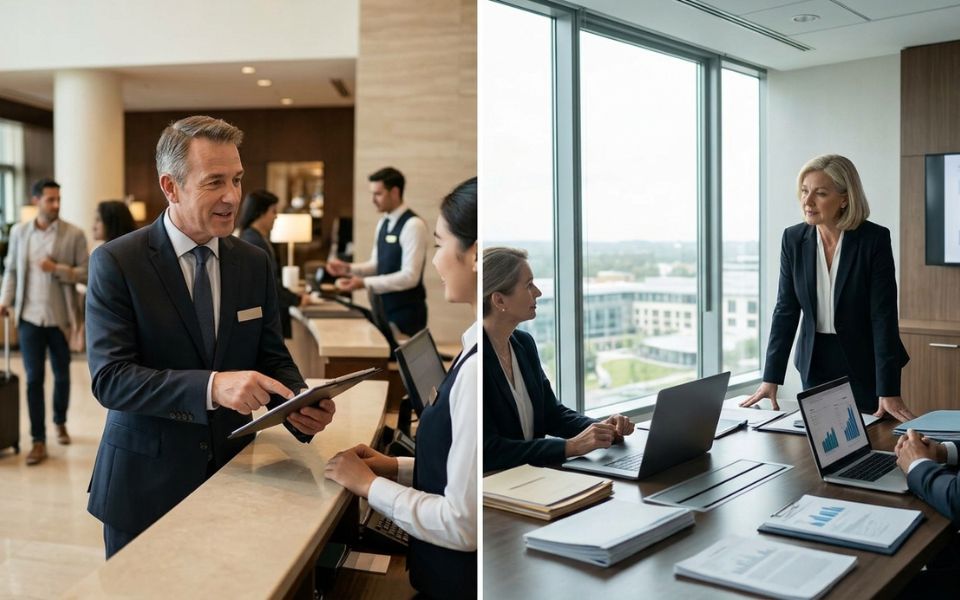
In hotel operations, there are many positions with different responsibilities. Two roles that are often considered the same are Hotel Manager and General Manager (GM).
Both play an important role in ensuring that a hotel runs smoothly. However, their scope of work and responsibilities are actually quite different.
Understanding the difference is important, especially for hotel owners, investors, and teams involved in hotel operations and marketing strategy.
What Is a Hotel Manager?
A Hotel Manager is responsible for the hotel’s day-to-day operations. Their main focus is making sure that each department runs efficiently and that guests receive an experience that meets the hotel’s standards.
Some of the Hotel Manager’s responsibilities include:
- Monitoring daily hotel operations
- Supervising departments such as Front Office, Housekeeping, Food & Beverage, and Engineering
- Handling operational issues and guest complaints
- Ensuring hotel service standards are maintained
- Coordinating between different departments
- Monitoring staff performance and operational needs
- Helping maintain guest satisfaction
Simply put, a Hotel Manager is more focused on how the hotel operates on a daily basis.
What Is a General Manager?
A General Manager, or GM, has a broader range of responsibilities. This position is typically responsible for the hotel’s overall performance, rather than just its day-to-day operations.
A General Manager needs to look at the hotel from multiple perspectives, including operations, finance, marketing, human resources, and overall business performance.
Their responsibilities may include:
- Setting the hotel’s direction and targets
- Overseeing the performance of all departments
- Monitoring revenue and profitability
- Making business decisions
- Overseeing sales and marketing strategies
- Maintaining relationships with owners or investors
- Evaluating the hotel’s overall performance
- Identifying ways to increase revenue and improve efficiency
Because of this, GMs are generally more involved in strategic and long-term decision-making.
In many hotel organizational structures, the General Manager holds a higher position because they have broader responsibility for the hotel’s overall business. The Hotel Manager typically reports to the GM and focuses more on daily operations.
However, organizational structures can vary depending on the hotel’s size, brand, and management system. Not every hotel follows the same hierarchy or has both positions.
Who Handles OTA Management in a Hotel?
Not every hotel has a dedicated team to manage online channels. At smaller properties, OTA-related tasks may be handled by the sales, reservations, or marketing team.
As the number of OTAs increases, managing rates, promotions, room availability, and performance across multiple channels can become more challenging.
Hotels can consider working with a Bali OTA service provider or a hotel ecommerce management service to help manage and optimize their online distribution channels.
An ecommerce team can assist with various aspects of online distribution, including room distribution, rate management, promotions, and OTA performance evaluation.
This allows General Managers and Hotel Managers to focus more on hotel operations and business decision-making, while online distribution is handled by a team with more specialized expertise.
With the right approach to online channel management, hotels can improve their visibility, increase booking opportunities, and potentially generate more revenue from their online distribution channels.